
Case: Robotic arm with food contact in automated production
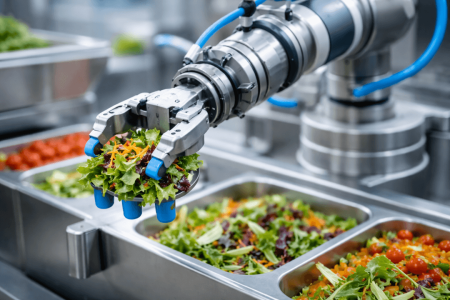
Automation places new demands on food contact
Several companies in the food industry today use robots to handle food – for example, for picking, dosing and packaging. When a robot arm is directly involved in food contact, there is often uncertainty about which rules apply and how to ensure correct documentation. Robotic arms with food contact therefore require a precise assessment of materials and contact zones.
Robotic arm with food contact – the challenge
A Danish food company needed to implement a robotic arm in an automated production line where the robot had direct contact with food. Although the robot as a machine was CE marked, there were doubts about:
- which parts were covered by the rules for food contact materials
- which materials required testing and documentation
- how compliance could be achieved without unnecessary testing and costs
The company wanted a clear, professionally based clarification.
FCMtesting's approach
FCMtesting conducted a technical review focusing on the actual use in production. We mapped contact zones and assessed which components were covered by food contact legislation, including Framework Regulation (EC) No. 1935/2004 and relevant specific regulation.
On this basis, a targeted testing strategy was determined based on contact conditions, usage patterns and risk assessment - with a focus on testing what is necessary and avoiding overtesting.
The solution
Selected components on the robot arm were tested according to applicable requirements. FCMtesting conducted an overall assessment of the results and assisted with the necessary documentation for use with authorities, customers and audits.
The result
- The robotic solution was documented as suitable for food contact
- The company achieved full compliance with applicable regulations
- Unnecessary tests and delays were avoided
- The robot could be put into operation with regulatory safety
Relevance to other companies
Automation and the use of robots in food production pose new and often complex requirements for food contact assessment. This case shows how a robotic arm with food contact can be handled correctly through a targeted and practical approach that ensures compliance for robotic solutions - efficiently, documented and cost-consciously.
Do you have a similar challenge?
We are happy to help assess materials, documentation and compliance in practice.
Contact us for a non-binding professional dialogue.